








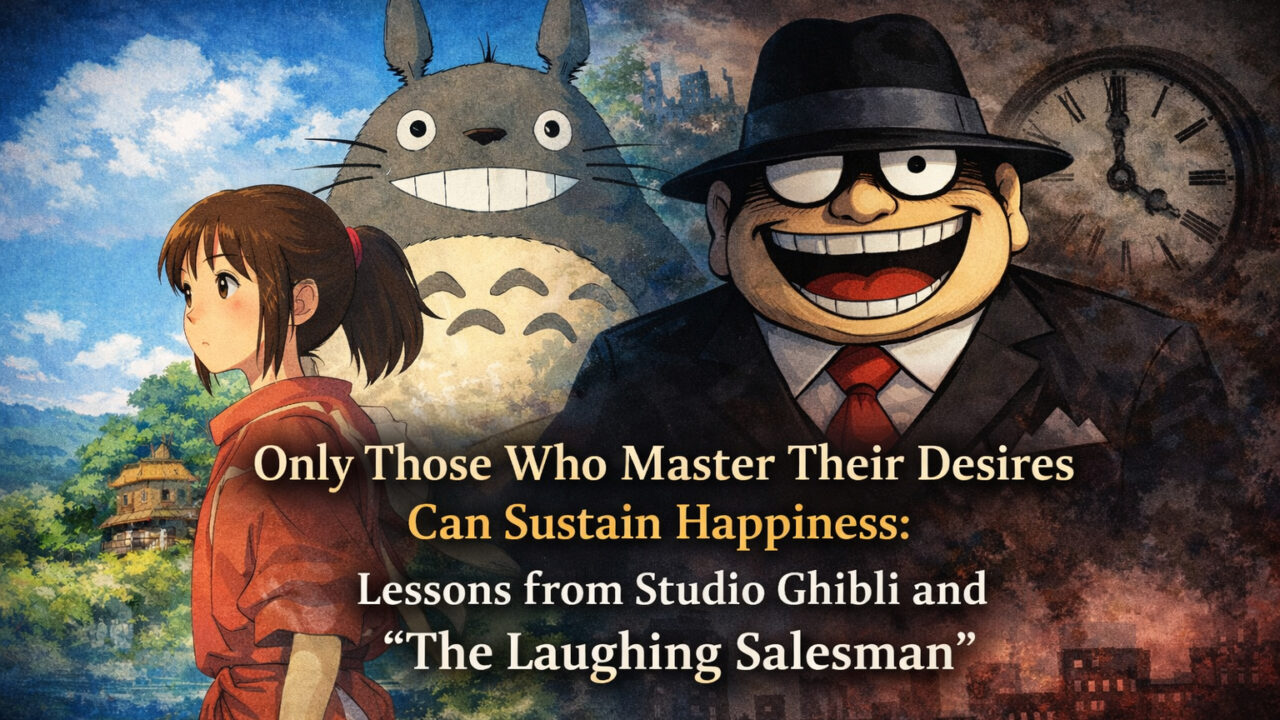
Only Those Who Master Their Desires Can Sustain Happiness: Lessons from Studio Ghibli and “The Laughing Salesman”
Stories that save the world are undeniably beautiful. But stories that illuminate the darkness of the heart can be painfully difficult to confront.
From the lush “outer worlds” of Studio Ghibli to the fragile “inner worlds” exposed by Moguro Fukuzo, we will explore the contrast between these two seemingly opposite narratives to find unexpected clues for achieving “Sustainable Happiness.”
Ghibli Paints the World; Moguro Strips the Soul
Studio Ghibli’s works have always posed a grand question: “How should we engage with this world?” These stories are filled with light, focusing on harmony with nature, kindness toward others, and the courage to choose restoration over destruction. They represent our efforts to better protect the world around us.
On the other hand, the masterpiece by Fujiko Fujio Ⓐ, The Laughing Salesman (Warau Salesman), faces a much more raw and personal realm. It is not about world peace or the environment; it is about your own heart.
If Ghibli tells the story of the “outer ideal” we should strive for, The Laughing Salesman is a fable that exposes the “inner reality” we often try to ignore.
Who is Moguro Fukuzo?
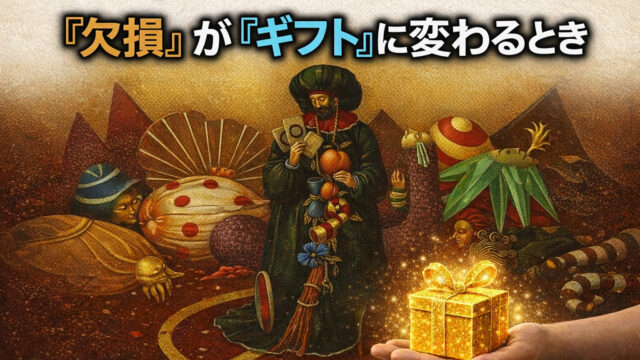
The protagonist, Moguro Fukuzo, appears with a signature catchphrase: “My name is Moguro Fukuzo, known as the Laughing Salesman. I am no ordinary salesman. The merchandise I deal in is the heart—the human heart itself.”
He claims to “fill the gaps in your soul,” but he never actually forces misfortune upon anyone. This is the most terrifying and profound part of the story. Moguro always presents a “condition” to his targets and makes a “promise.” Yet, in the end, it is always the person themselves who breaks that promise.
In this sense, Moguro is less like a demon manipulating fate and more like a device that visualizes the consequences of one’s own choices. His famous “BOOM!” (Doon!) is not a one-sided punishment. It is simply the moment where “Karmic Retribution” becomes visible, showing you exactly where the path you chose has led.
The “Bottomless Pit” of Human Desire
The reason this work has been loved and feared for decades is its portrayal of raw human desire:
-
The urge to make money with zero effort.
-
The thirst for constant validation and fame.
-
The wish for instant success without the work.
The lesson that “shortcuts always come with a price” is a classic one. However, this story shows something deeper than simple morality. it reveals the inescapable fact that the cause of our unhappiness may not be bad luck or our environment, but the weakness within ourselves.
Desire itself is not evil. But when we let desire take the wheel—when we deceive ourselves just to get a taste of “sweet success”—we inadvertently call upon Moguro Fukuzo.
Is Moguro Evil, or is He a Mirror?
What is the true nature of Moguro Fukuzo? There are several interpretations:
-
The Embodiment of Karma: A force like a law of nature that simply shows the result of a broken promise.
-
The Ruthless Educator: A guide who uses ruin as a “shock therapy” to make people realize their mistakes.
-
The Cynical Observer: As the title suggests, someone who just stands by and laughs at human weakness.
The interpretation that feels most right is that he is a “Mirror.” Moguro doesn’t “do” anything to us. We are simply looking at the results of our own desires through his lens. We fear him because, deep down, we know we are struggling to keep the promises we made to ourselves.
A Quiet Warning to Modern Society
This story remains surprisingly relevant today because the struggling adults depicted in it are no different from us.
-
Persistent loneliness.
-
Unstoppable vanity.
-
An oversized need for approval.
-
Excessive dependence on distractions.
While Ghibli asks, “Can we save this beautiful world?”, Moguro Fukuzo whispers in our ear: “Are you holding the reins of your own heart?”
The Intersection with Sustainable Happiness
“Sustainable Happiness” is not about perfecting your external conditions. It is not about becoming a saint and erasing all desire. And it is certainly not about running away from figures like Moguro.
The key is recognizing your own desires and taking full responsibility for your choices.
-
The power to keep promises to yourself.
-
The integrity to not deceive yourself.
This is the only way to cut through the sweet temptations that try to fill the “gaps in the soul” and avoid self-destruction. Moguro is not a hero who comes to save us. However, he is a philosophical presence that offers a powerful wake-up call: “Have you lost sight of yourself?”
Conclusion: Face the “Gap in the Soul”
Is Moguro Fukuzo a savior or a destroyer? The answer might be simpler: He is just standing there, reflecting our inner selves and showing us the shape of the “gaps” we didn’t even know we had.
If that is the case, the person we truly need to face is not the man in the black suit, but the “unfilled something” within our own hearts.
Will you fill that gap with easy external stimuli? Or will you fill it slowly through a sincere, daily walk? Each of those choices is what ultimately builds your Sustainable Happiness.